![[Kanazawa] Beauty and stories embodied in Kutani ware](https://resources.matcha-jp.com/resize/720x2000/2025/09/16-244377.webp)
Kutani ware is a traditional craft that Ishikawa Prefecture is proud of, and the tradition began nearly 400 years ago. This time, we will introduce the history of Kutani ware and the wishes that are embedded in its patterns.
![Resol Hotels -Chubu- [Kanazawa, Nagoya, Gifu]](https://resources.matcha-jp.com/resize/100x2000/2025/03/12-227694.webp)
Written by
Our Resol Hotel was born to weave unique stories rooted in each region and become a microcosm of the city. Just as each city has its own unique shape, we welcome visitors with a different face. Hotel Resol Trinity Kanazawa ~Time you can only get in this city~ Kanazawa, the largest city in the Hokuriku region, is also known as the Kaga Hyakumangoku. Its history began in 1546 with the Kanazawa Mido temple built by Ikko sect followers, and during the reign of the O-Omameda clan during the Warring States period, traditional culture such as crafts and performing arts developed. Hotel Resol Trinity Kanazawa was born to convey the unique charm that only Kanazawa has, and to be a base for cultural inheritance and urban development. Hotel Resol Trinity Kanazawa offers a "connection" to traditions and culture that can only be found here. Experience a rich time filled with the splendor of the Kaga Hyakumangoku at Hotel Resol Trinity Kanazawa. Hotel Resol Nagoya ~A hotel with suits and sneakers~ This urban American-style hotel, with the theme of "suits and sneakers," sprinkles the taste of jazz, a musical culture unique to his country, throughout the building, creating an exquisite balance between tension and relaxation. The space, which pays attention to every single detail, from the materials to the furniture, objects, and accessories, invites travelers who seek the real thing to deep relaxation, like an "adult hangout." Hotel Resol Nagoya is a hotel for adults, where you can relax in a sophisticated space that exudes the scent of good old culture and intelligence. Hotel Resol Gifu ~Experience the culture and history nurtured by clear streams with all your senses~ Beautiful mountains overflowing with greenery. Clear streams that seem to cleanse your soul. Gifu, blessed with beautiful natural scenery and clear waters, has a long history as a city that lives with water. Just a 20-minute walk from the hotel, you will come across the city's only natural waterfall, which flows from the mountain stream originating from Momoga Mine. The scenery changes with the seasons, and you will be impressed with something new every time you visit. The feelings of the people that are imbued with water, and the industries and cultures that have been nurtured there. Hotel Resol Gifu cherishes this relationship between people and water. Please enjoy to your heart's content the story that is woven at Hotel Resol together with the city and the people.
Hotel Resol Trinity Kanazawa
All tourist spots in Kanazawa City are within walking distance.
Omicho Market is within a 1-minute walk, making it a convenient base for sightseeing in Kanazawa.
We welcome you with colorful flowers and Kaga Temari art.
![[Kanazawa] Beauty and stories embodied in Kutani ware](https://resources.matcha-jp.com/resize/720x2000/2025/09/12-244165.webp)
-
Table of Contents
- The beginning of Kutani ware and the baton that has been passed down to the present day
- Wishes contained in bold patterns
- Lobby service using Kutani ware
The beginning of Kutani ware and the baton that has been passed down to the present day
Kutani ware is a traditional craft that Ishikawa Prefecture is proud of. Its origins date back to around 1655, during the early Edo period, when Maeda Toshiharu, the first lord of the Daishoji Domain (a branch of the Kaga Domain), commissioned Goto Saijiro, who had studied ceramics manufacturing in Arita, to open a kiln. The "Kokutani" style that emerged during this period is characterized by its bold, five-color painting (green, yellow, purple, deep blue, and Aka), and has captivated people as an art form that transcends the boundaries of tableware.
However, Ko-Kutani disappeared after about 50 years. Then, 100 years later, the Kaga domain invited Kyoto literati painter Aoki Mokubei to open the Kasuga Kiln in Kanazawa . Kutani ware was revived once again, and unique kilns such as Yoshida Kiln and Shozo Kiln were born one after another, each of which developed its own unique style.
During the Meiji period, Shozo Kutani's colored gold brocade was praised on the world stage, and the name spread as "Japan Kutani." Nowadays, many artists, including Living National Treasure Yoshida Mito, continue to create new Kutani ware while preserving tradition.
Wishes contained in bold patterns
There are many typical designs in Kutani ware.
Among them, the style known as "Aote" is characterized by a bold design in which the entire vessel is painted in vibrant green, giving it a presence reminiscent of a painting.
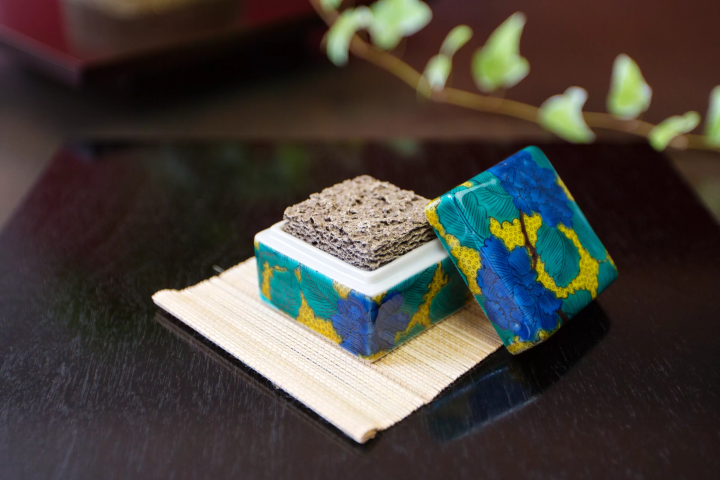
Furthermore, the "Ume-Kiku-mon" design, which depicts a pattern of plum and chrysanthemum, is imbued with delicate beauty and powerful meanings such as "patience," "vitality," and "longevity," and the silence that resides in the vessel resonates in the heart, like a prayer.
![[Kanazawa] Beauty and stories embodied in Kutani ware](https://resources.matcha-jp.com/resize/720x2000/2025/09/16-244372.webp)
In fact, the family crest of the Maeda clan, who were the lords of the Kaga domain, was the "umebachimon," which also features a plum blossom motif and symbolizes strength and prosperity.
You will see them in various places around Kanazawa, so be sure to look for them.
Lobby service using Kutani ware
Our hotel offers Kutani ware as a welcome drink. Upon arrival, guests will enjoy fragrant coffee in a Kutani ware cup. In addition, we have prepared edible gold leaf as a luxurious touch unique to Kanazawa. Guests can sprinkle the sparkling gold leaf on the drink with their own hands, which will not only enhance the beauty of the dish but also leave a lingering, elegant aftertaste on their palate.
![[Kanazawa] Beauty and stories embodied in Kutani ware](https://resources.matcha-jp.com/resize/720x2000/2025/09/16-244375.webp)
A cup of coffee poured into a Kutani ware cup is more than just a drink: it is a small gift that subtly conveys Kanazawa's history and aesthetic sense, as well as feelings of gratitude and welcome to customers.
Please enjoy the beginning of your journey as you listen to the story told in the cup and the sparkle of the gold leaf. We hope that this cup will become a warm memory that will stay in your heart.







![[Tokyo, Shinjuku] Buy Matcha Here! 2 Long-established Japanese Tea Shops Where You Can Get the Authentic Taste!](https://resources.matcha-jp.com/resize/720x2000/2025/09/24-245090.webp)