HIROSHIMA ORIZURU TOWER offers more than just a rooftop observation deck; the SPIRAL SLOPE "Sampo," along the way is also a must-see. Through the massive WALL ART PROJECT "2045 NINE HOPES," which spans nine levels of slopes, we introduce the charm of walking itself as a special experience.

Written by
HIROSHIMA ORIZURU TOWER is a tourist facility that opened in 2016 next to the Atomic Bomb Dome, a world heritage site, offering a space you've never seen or felt before. The breeze blows through the rooftop observation deck, offering views of the Peace Memorial Park, the Atomic Bomb Dome, and on clear days, Mount Misen on Miyajima. At ORIZURU SQUARE on the 12th floor, you can fold a crane using special origami paper and throw it into the 50m-high glass-walled ORIZURU WALL. Also on the first floor, there is a product hall selling locally loved products and a cafe where you can taste ingredients from Hiroshima.
More than just an observation deck! How to enjoy HIROSHIMA ORIZURU TOWER
Located right beside the World Heritage Site, the Atomic Bomb Dome, is the HIROSHIMA ORIZURU TOWER. While the HIROSHIMA ORIZURU TOWER is known for its open-air observation deck, its charm extends far beyond the observation deck! Connecting the rooftop observation deck to the first floor is the nine-tiered spiral ramp, the SPIRAL SLOPE "Sampo." Along the ramp, a giant WALLART depicting wishes for the 100th anniversary of the end of the war is displayed on the walls. The tower is designed so that ordinary travel time transforms into a special experience before you know it.
This time, we'll be focusing on the WALLART located on "SPIRAL SLOPE "Sampo" the setting for the story!
What is the WALL ART PROJECT "2045 NINE HOPES"?
"2045"—100 years after Hiroshima was bombed. That future is drawing closer, within reach. Artists from each generation, from their 20s to their 90s, who represent "the generation that created the past," "the generation that is creating the present," and "the generation that will create the future," have depicted their "wishes for 2045" that they want to leave for future generations through art. What do these Hiroshima-connected artists hope for in the world 100 years after the war? You can simply accept it as you feel it intuitively, or you may gain a different perspective by knowing the background of each artwork. Let's take a look at the artists who represented each generation and what their paintings mean.
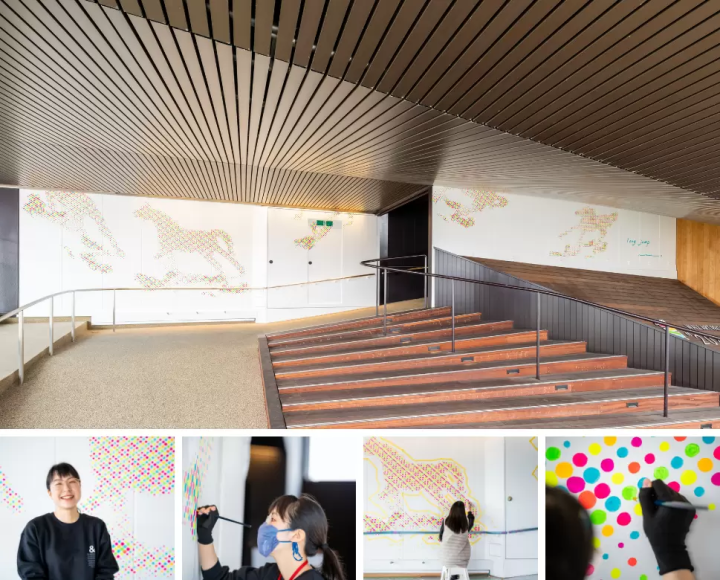
Layer 9: Kiko Doi "long jump"
Born in Yamaguchi Prefecture in 1997. After studying oil painting at Hiroshima City University, Faculty of Arts, she now creates two-dimensional works using abstract expression with layered structures.
The image depicts a galloping horse and its shadow. The "shadow" symbolizes Hiroshima's history. The galloping horse represents moving forward while carrying the past with it. The dots represent the "eternal rebirth of the origami crane." The wish for peace will never fade, but will be eternal. This wish is embodied in the design.
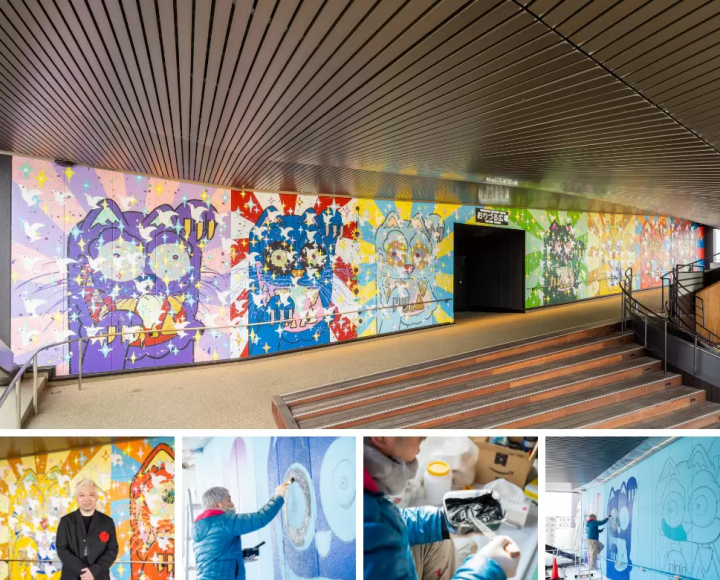
Layer 8: Shinichi Wakasa "There are different people living on this earth."
Born in Hiroshima Prefecture in 1982. Completed a Master's program at Hiroshima City University Graduate School. Focusing on Japanese culture and religious views, she incorporates elements characteristic of manga, games, and anime into her works. She is active both domestically and internationally.
Seven beckoning cats are depicted in rainbow colors. The stars represent the sparkle of life that the beckoning cats create. A message is depicted with white doves, symbols of peace. In the eyes of the beckoning cats, a wish for peace is written in English, Japanese, and Ukrainian.
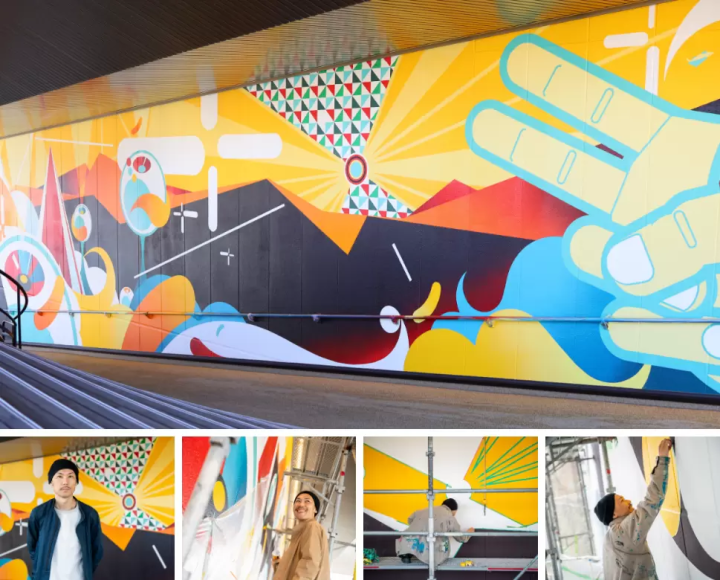
Layer 7: SUIKO "Morning era"
Born in Hiroshima in 1979, his unique color theory is characterized by a blend of Japanese wabi-sabi aesthetics, European sensibilities, and a contrasting aggressiveness. He has collaborated with various companies, including Walt Disney and Coca-Cola, on numerous projects.
This artwork was created based on the first sunrise of the year, viewed from Futabayama on New Year's Day 2022, and the cityscape of Hiroshima. The sight of people gathered at the summit, all watching the same sunrise, was filled with a very positive and peaceful atmosphere. It embodies the wish for a world where everyone can equally feel the light .
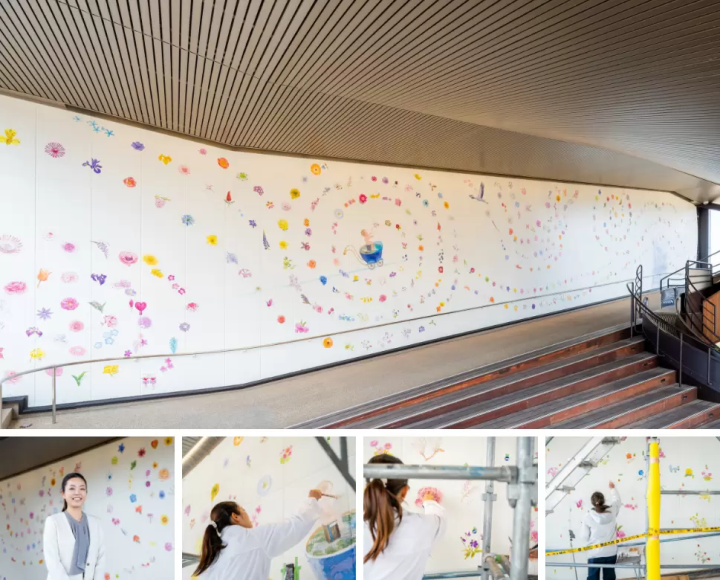
Layer 6: Miki Tanaka "Ouka 366 birthday flowers"
Born in Fukuyama City, Hiroshima Prefecture . She went through a period of uncertainty about painting, finding it difficult to face a blank canvas. However, one day, she gave a painting of a man's dream to a man whose dream had been sealed away by an unfortunate accident. This experience made her realize that "she can paint for the sake of someone's important feelings." She continues to work as a "vision projector," visualizing thoughts.
The motif is the birth flower for each of the 366 days of the year. Regardless of nationality, age, or gender, everyone born into this world has a birthday. The 366 flowers represent all life. We hope that you will make the most of your individuality and characteristics and bloom your own unique flower. And the flowers will become a flow, a vortex, and create a new era. That is the message behind it.
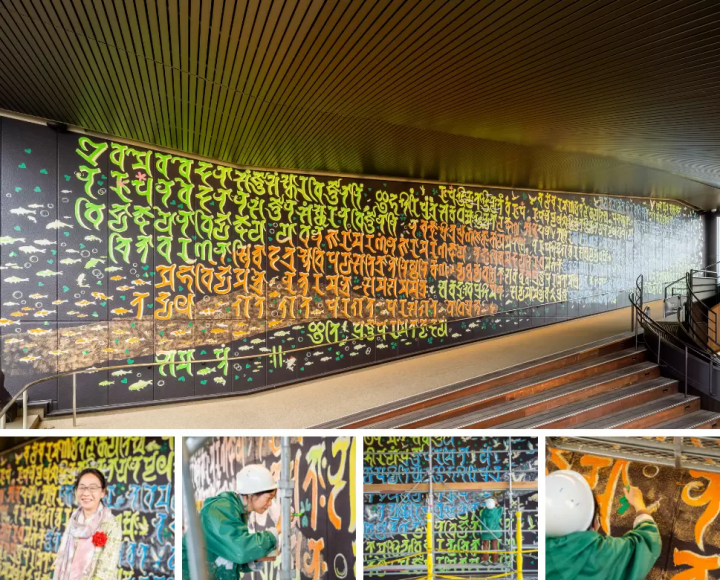
Fifth layer: Fumiyo Kono "Heart Sutra"
Born in Hiroshima in 1968. Debuted in 1995 with "Machikado Hana Dayori" . Major works include "Yūnagi no Machi, Sakura no Kuni" , "Kono Sekai no Katasumi ni" , and "Ballpoint Pen Kojiki" .
To someone living in 2045, this area was once filled with countless thoughts of "memorial." Those souls were beings who were meant to be connected to us, who live in the present, in some way. I wanted to record that. It is with this thought that the "Heart Sutra" is depicted. It begins with a dove, a Carp fan, and ends with a carp, a Carp fan. The carp represents love, and the dove represents peace. Please try to find it.
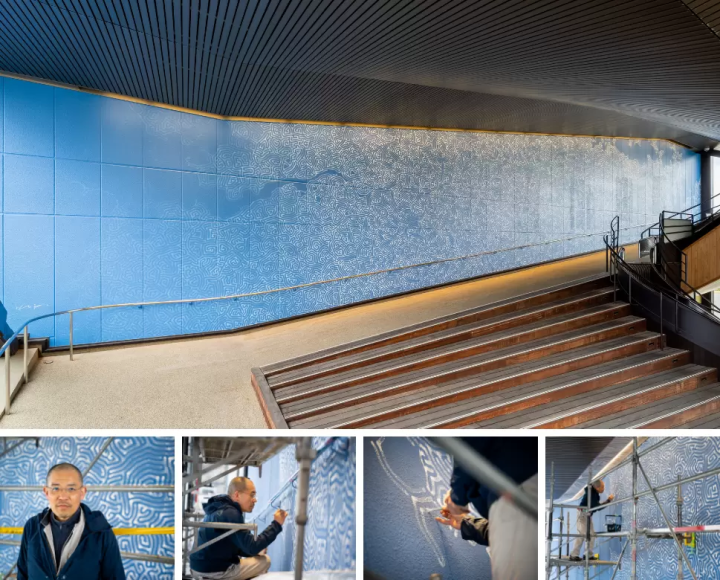
Fourth layer: Motoi Yamamoto, "A PATH TO THE BLUE SKY"
Born in Onomichi City , Hiroshima Prefecture Prefecture. To remember his wife and sister who passed away at a young age, he creates installations using "salt," which evokes feelings of purification and cleansing. His works have been exhibited in numerous venues both in Japan and abroad, including the Museum of Modern Art (MoMA) PS1 in New York, the Hermitage Museum, and the Museum of Contemporary Art Tokyo.
This artwork depicts the flow of time and the continuity of people's thoughts, connecting the day when our daily lives were snatched away in an instant to the present and the future, like white clouds spreading across a blue sky. The blue color of the wall was chosen to be the closest to the sky at 8:15 a.m. on August 6, 1945. It embodies the wish that people living in the world of 2045 will be able to look up at a clear blue color that they can truly find beautiful.
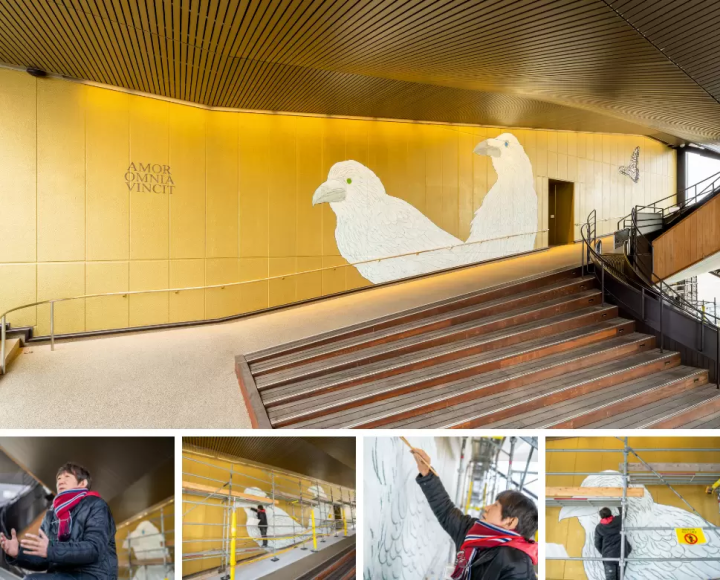
Third layer: Masanori Mimasu, "White Crow"
Born in Hiroshima Prefecture, he creates art based on the theme of "Japanese Modern." In 2011, he produced sliding screen paintings and hanging scrolls for a tea room. To this day, his works are displayed in many temples, shrines, and tea rooms, including Daitoku-ji Temple in Kyoto and Jodo-ji Temple in Onomichi.
White-feathered crows are generally said to be a symbol of something impossible. Two large crows, looking powerfully towards the future, face the direction of the hypocenter, symbolizing those who will forge a path to the future. It is thanks to the "strength" and "resilience" that the people of Hiroshima overcame before us that the peaceful Hiroshima we have today, which was thought impossible at the time, exists.
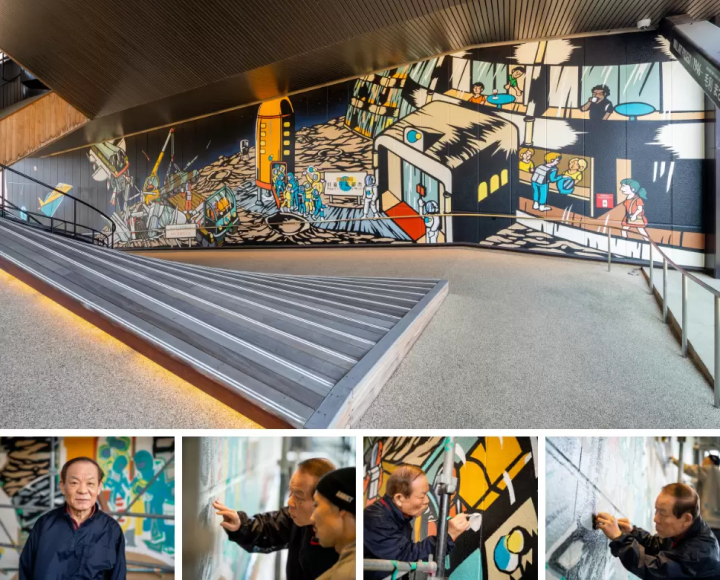
Layer 2: Masamichi Mouri, "Moon of the City of Peace"
Born in Kumamoto Prefecture, currently residing in Hiroshima City. Self-taught paper-cutting techniques in his 40s. He has won numerous awards in the handmade picture book category, including the Minister of Education's Encouragement Award and the Yomiuri Shimbun Award. After his debut with the picture book "Momo no Sato," he has also worked on calendar illustrations and magazine covers.
From space, no national borders are visible on Earth. Space belongs to no one, and it's impossible to draw national borders in this infinite space. The day is near when cities will be built somewhere in space. This artwork embodies the idea that there, all of humanity will live in equality and peace.
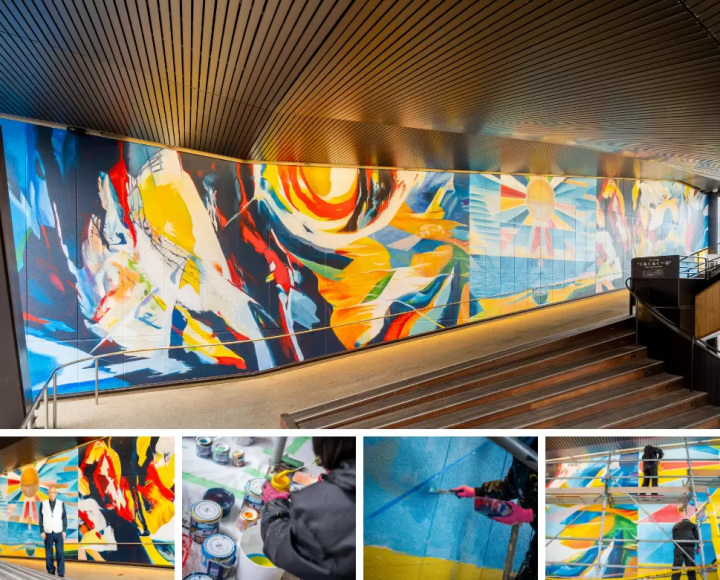
Layer 1: Tsuneki Miura "Crawl Towards the Light"
Born in Tokyo in 1930. After moving to Hiroshima, he was exposed to the atomic bomb at the age of 15. He currently lives in Yamagata. He continues to depict the horrors of the atomic bomb in oil paintings.
This piece combines three works that the artist continued to depict as representations of the atomic bomb. The works on the left and right focus on destruction, while the middle work expresses a wish for peace, depicting the sunset over the Sea of Japan in Yamagata Prefecture, where the artist has lived since the bombing. The artist believes that this scenery itself embodies the image of peace.
Walking becomes an experience
The SPIRAL SLOPE "Sampo," is not just a passageway connecting the rooftop observation deck and the first floor. It is a space designed as an "experience" where the scenery changes with every step you take, and before you know it, you are surrounded by art.
The vibrant colors and expressions spread across the walls offer countless moments you'll want to capture in photographs. Walking itself becomes part of the journey. When you visit HIROSHIMA ORIZURU TOWER, be sure to take your time and enjoy the time before and after your visit to the observation deck.




![[Tokyo, Shinjuku] Buy Matcha Here! 2 Long-established Japanese Tea Shops Where You Can Get the Authentic Taste!](https://resources.matcha-jp.com/resize/720x2000/2025/09/24-245090.webp)