

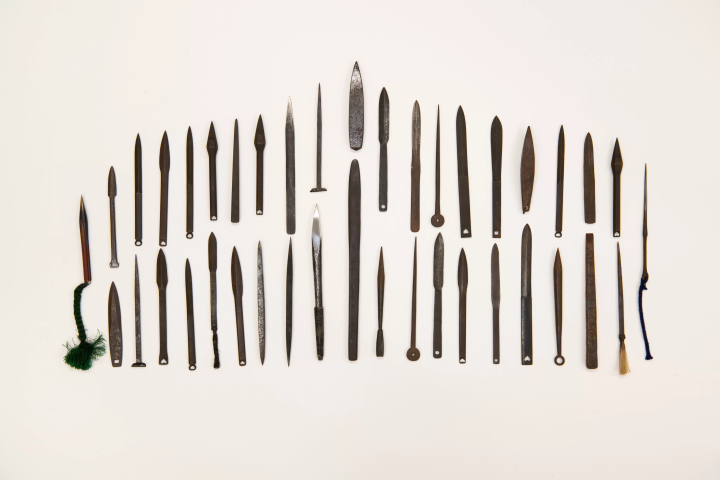
The Iwabisu Sanada Ninja Museum ``Ninpaku'' has about 300 authentic ninja tools and weapons from 400 years ago. The largest permanent exhibit in Japan, including shurikens, chain sickles, chain tools, intrusion tools, fugue tools, deadly weapons, and mechanical tools. By visiting this exhibit, you will be able to see the true nature of the mysterious ninja. It's both a serious museum and a fun theme park that is essential when talking about ninjas.

Written by
With the motto "Don't you have fun playing with history!?", we will explore Japan's outstanding historical culture, ninjas, Sengoku Sanada, and Iwabitsu Castle , which were hidden in Higashi-Agatsuma town, Gunma Prefecture. We offer authentic experiential sightseeing. Speaking of ninjas, we think of Sarutobi Sasuke and Kirigakure Saizo's "Sanada Ten Braves." Higashi-Agatsuma town of " the Agatsuma Sanada Ninja ", which was the model for this. There are historical sites and folklore that leave behind their footprints and activities, and there are also descendants who can tell you stories. Ninjas are associated with superhuman physical abilities and martial arts, but in Higashi-Agatsuma town cho there is a real image that goes beyond that. This is a small facility where you can play and learn through exhibits and hands-on experiences that tell the true story of Shugen monks like Yamabushi, ninjas who are experts in medicine, and ninjas who were respected by the local people who risked their lives to survive. Approximately 300 ninja weapons and tools are on permanent display. All the items are authentic, collected not only from Agatsuma but also from all over the country. In addition to shurikens and kusarigama, there is a wide array of actual equipment that tells the story of ninja activities, such as tools for infiltration and destruction, fugue tools, contraption weapons, and ninjutsu books. On the exhibition floor, projection mapping and floor interactives depicting the Agatsuma Sanada Ninja are occasionally shown, and the ceiling lights also move while changing colors, creating a space that resembles a chemical ninja art. It is designed so that even those who are not interested in it can enjoy it. When you leave the exhibition floor and head to the attraction floor, there is a shuriken experience corner where you can try throwing iron shuriken at a target. If you pour your daily stress into the target, all your worries and worries will be blown away. Beyond that is VR Chanbara "VS Sanada Yukimura". You can experience for yourself the strength of Yukimura Sanada's army, which was called ``Japan's best soldiers'' during the Sengoku period. It is a battle game that can be experienced by children aged 7 and up and is exciting for both children and adults. Further inside, there is also a laser shuriken shooting showdown where players are divided into two teams and aim at sensor-equipped targets using shuriken terminals that emit lasers. A safe and easy attraction that even small children can enjoy. When you go up to the second floor, a sensor-linked laser trap network will appear in the room. If you pretend to be a ninja or a spy and complete the mission by dodging the lasers within the time limit, you too will become a fine Agatsuma ninja. Around the perimeter of the facility, there is a memorial monument for the Agatsuma seven knights of Azuma. After enjoying Ninpaku, please report to this monument that you became an Agatsuma ninja.
What Ninpaku's ninja tools can teach us
Ninjas are not just superhuman warriors
Shurikens are not the only ninja tools. Ninpaku exhibits, such as the ``Shikomi Cane,'' are important tools used by ninjas who hid themselves from travelers as they walked through the mountains and fields of the country searching for enemies. Walk while poking the cane at the same intervals and rhythm. A well-trained ninja keeps the same distance with each step no matter where he walks or how long he walks. Walk while chanting the Heart Sutra as you walk. The number of steps each ninja takes per chant is determined by each ninja. Once you finish chanting, send one rosary ball. When the rosary beads go around once, it means that the rosary has been recited 108 times, and the distance walked can be determined by the number of times the rosary is recited and the length of each step. In other words, even if you have never been to a place, you can know the distance from your castle. When attacked by enemies or bandits on the way, fight back with hidden chain weights. But fighting is not the purpose. Their job is to use the various tools on display at Ninpaku, such as the ``blind blind'', ``kakute'', and ``hakubishi'', to run away and bring the information they have researched back to their territory alive. Therefore, you can learn about the real ninja, which is different from the image of people who fight by shooting multiple shuriken, jumping to high places, and running as fast as the wind. How to stay inconspicuous, how to blend into society, how to secretly obtain information, how to escape deftly, and how to live to pass the information to the boss. It was an intelligence that had acquired what was necessary for that purpose, such as ``language,'' ``dialect,'' ``literal knowledge,'' ``cultural education,'' ``pharmaceutical/medical science,'' ``entertainment,'' ``political and economic knowledge,'' and the ability to survive. From the cultural assets on display at Ninpaku, you can see the true nature of ninjas, human wisdom, and Japanese culture.

Proof that there were ninjas here
The Ninpaku exhibits were collected from all over Japan over the course of 50 years by Kenji Yamagishi, Japan's number one collector of ninja tools. Most of them are not from Agatsuma, which has garlic. However, there are also ninja tools found here in Agatsuma. These include ``blinding'', ``topping'', ``bo shuriken'', and ``folding shuriken''. It was used as a practical tool by the ninjas of the Sengoku Sanada clan at Iwabitsu Castle.
Shadow calls light.
Ninpaku has dug up the real ninja culture, the historical culture of the local Agatsuma the Agatsuma Sanada Ninja, and brought it back to the present. Get a closer look at the true nature of ninjas through their exhibits that have disappeared into the darkness for 400 years, think about what war is, what peace is, and learn about ``light'' as a way to survive in the chaotic modern times. , is that kind of museum.










![[Tokyo, Shinjuku] Buy Matcha Here! 2 Long-established Japanese Tea Shops Where You Can Get the Authentic Taste!](https://resources.matcha-jp.com/resize/720x2000/2025/09/24-245090.webp)





![[Kyoto Prefecture ] Let's go see Fukuchiyama Castle, the symbol of Fukuchiyama City | Highlights and seasonal events](https://resources.matcha-jp.com/resize/720x2000/2026/02/12-258435.webp)
![[Gozaisho Ropeway] Gourmet Guide](https://resources.matcha-jp.com/resize/720x2000/2025/12/03-251960.webp)