

The most vibrant day in Murakami City, Niigata Prefecture, is the Murakami Grand Festival on July 7th. This festival of the Nishina-mi Haguro Shrine, featuring 19 beautiful floats parading through the city streets, was added to the UNESCO Intangible Cultural Heritage list as "Mountain, Float, and Procession Festivals" after deliberation in December 2025.

Written by
Murakami City, located at the northern tip of Niigata Prefecture, has a townscape full of historical atmosphere centered around the ruins of Murakami Castle, as well as the scenic beauty of the Sasagawa Nagare, which boasts a splendid seascape, mountains, rivers, and countryside that bring bountiful blessings, and Senami facing the Sea of Japan. You can spend quality time relaxing in the hot springs while watching the sunset. There are many delicious dishes that can only be tasted in Murakami, such as salmon dishes such as ``salted salmon'', Murakami beef, and Koshihikari rice from Iwafune. We will introduce you to the charms of Murakami, a city of history, tradition, rich nature, and gourmet food.
-
Table of Contents
- What is the Murakami Grand Festival?
- Characteristics of the Murakami Grand Festival
- Highlights of the Murakami Grand Festival
- Please come to the Murakami Grand Festival in 2026!
- How to get to Murakami City, Niigata Prefecture
- Souvenirs from Murakami City
- Food events to enjoy during the Murakami Grand Festival
- Clothing and belongings during the Murakami Grand Festival
What is the Murakami Grand Festival?
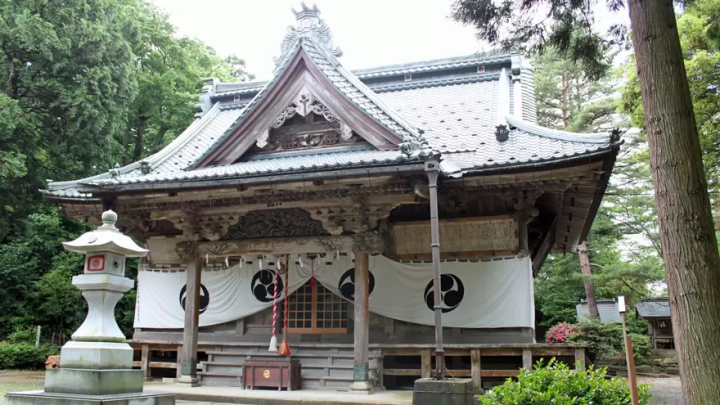
The Murakami Grand Festival is the festival of Senami-Haguro Shrine in Haguro-cho, Murakami City. It originated in 1633 when Hori Naoyori, the then lord of the Murakami domain, felt it was disrespectful to have the shrine overlooked from the castle and moved it to its current location. The relocation ceremony was held on the 7th day of the 6th month of the lunar calendar, and it is said that the festival began when townspeople, celebrating this, placed drums on carts and paraded through the town. In the present day, with the adoption of the Gregorian calendar, the eve of the festival is held on the 6th of July and the main festival on the 7th.
The Murakami Grand Festival is considered one of Niigata's three major festivals (Takamachi), and attracts many visitors every year. In addition, one of the highlights of the Murakami Grand Festival, the procession of festival floats, was designated a National Important Intangible Folk Cultural Property in 2018 as "Murakami Festival Float Procession," and will be added to the UNESCO Intangible Cultural Heritage list "Mountain, Float, and Festival Processions" in 2025.
Characteristics of the Murakami Grand Festival
The Murakami Grand Festival is a "traveling ritual" in which the divine spirit of Nishina-mi Haguro Shrine is transferred to three portable shrines and paraded through the streets of Murakami. In front of the portable shrines are the "sendatsu," who carry the lead drums, 14 horses, and a procession of children, followed by the floats (commonly known as "oshagiri") from 19 neighborhoods. The floats are gorgeously decorated with dolls and other ornaments called "norimono," as well as carvings painted with gold leaf and lacquer. Inside the floats, children play flutes, gongs, drums, and other instruments to create festival music.
First drum
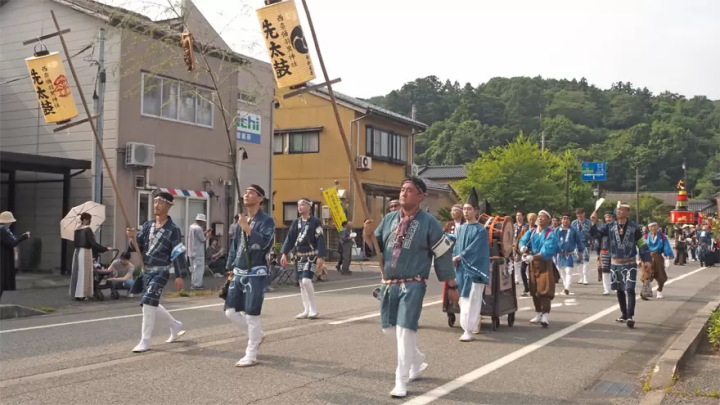
To signal the start of the Murakami Grand Festival, the procession moves through the town, beating drums in a rhythmic tempo.
14 Arauma
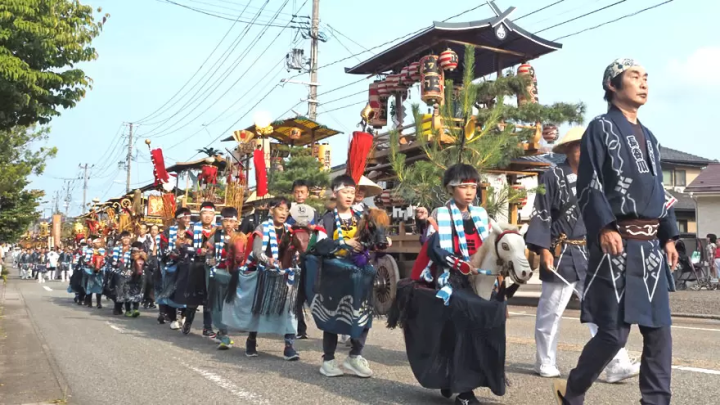
This event recreates the scene from 1587 when the then-lord, Honjo Shigenaga, returned triumphantly carrying a divided spirit from Mount Haguro (Yamagata Prefecture). Local elementary school students march in costumes that resemble horseback riding.
Sarutahiko, shrine maiden, and child procession
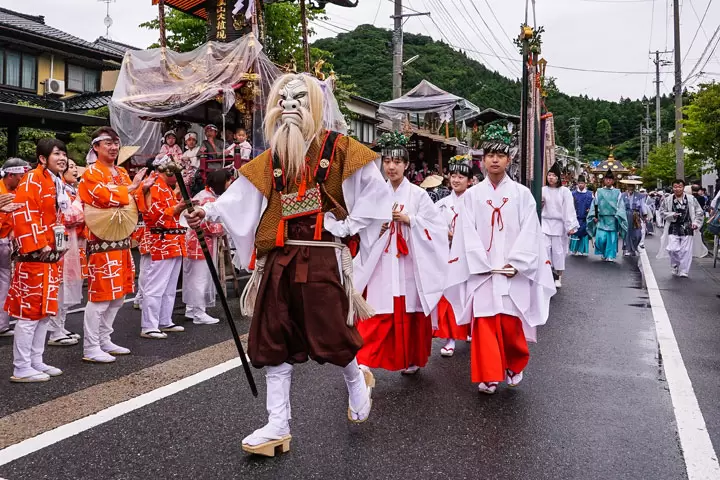
In front of the portable shrine carrying the divine spirit, Sarutahiko, the "Great God of Path Opening," along with shrine maidens and child attendants, proceeds.
portable shrine
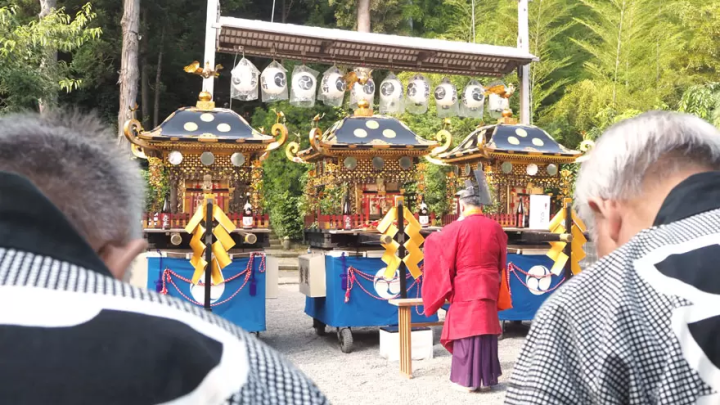
The deities of Nishina-mi Haguro Shrine, Natsuhime-no-Mikoto, Uganomitama-no-Mikoto, and Tsukuyomi-no-Mikoto, are transferred to three portable shrines and paraded through the town.
Street food stall procession
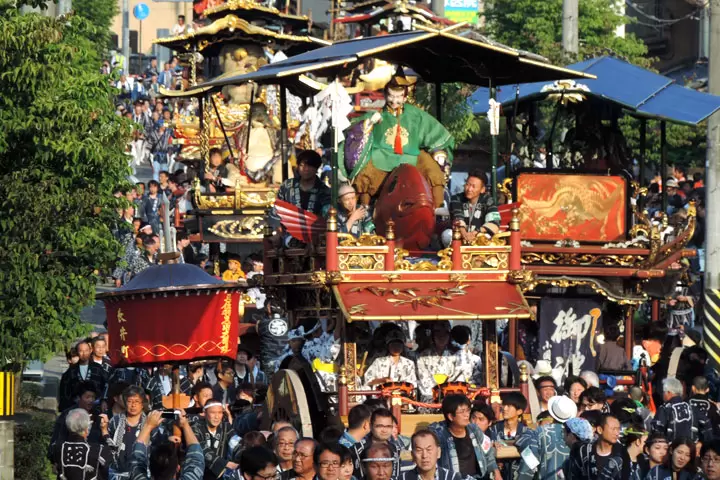
Following the procession of the portable shrine are the floats from the 19 neighborhoods. There are three types of floats: Shagiri floats, Hayashi floats, and Niwaka floats, each with its own unique character. Some floats are adorned with large "toppings" such as a huge Tengu mask, a chicken riding on a drum, or a Hotei statue with a changing expression, while others move along briskly to lively music, making for a spectacular sight.
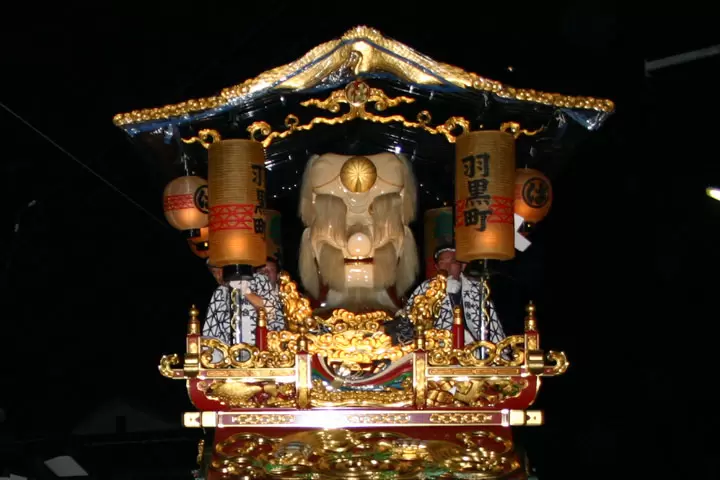


The procession of floats at the Murakami Grand Festival was designated a National Important Intangible Folk Cultural Property in 2018 as "Murakami Festival Float Events." It was also added to the UNESCO Intangible Cultural Heritage list in 2025.
Highlights of the Murakami Grand Festival
The Murakami Grand Festival takes place over two days, on July 6th (eve of the festival) and 7th (main festival). This year, an event celebrating the festival's registration as a UNESCO Intangible Cultural Heritage will also be held on July 5th, the day before the festival. Here are some of the highlights.
*The times are approximate (they may vary depending on the progress of the procession).
[July 5] Celebration Event for UNESCO Intangible Cultural Heritage Registration
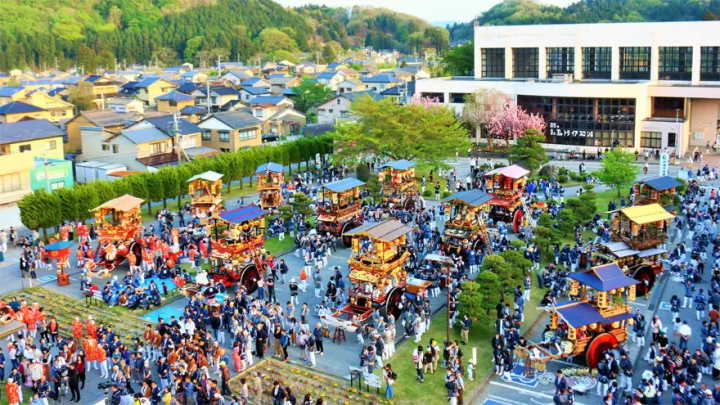
To celebrate the inscription of the Murakami Grand Festival (the float procession of the Murakami Festival) as a UNESCO Intangible Cultural Heritage, the festival floats will gather in the parking lot in front of the Murakami City Hall for a ceremony followed by a parade of the floats.
Date: July 5, 2026 (Sunday) 15:30-16:30
Location: 1-1 Sannomachi, Murakami City, in front of the Murakami City Hall building parking lot.
[7/6] Evening Festival

With the main festival just a day away, each neighborhood parades its festival floats through the streets to showcase them and give them a chance to be tested.
Date and Time: Monday, July 6, 2026, around 2:00 PM to evening (times may vary by neighborhood)
Location: Each neighborhood
[7/7] Komachizaka's "Sakagakari"

Just after midnight, around 2 AM, the Kubota-machi float races up Komachi Slope in Komachi, Murakami City.
Date and time: Tuesday, July 7, 2026, around 2:30-3:30
Location: Komachi and Komachizaka area, Murakami City
[7/7] Food stalls gather in front of Nishina-mi Haguro Shrine

Nineteen festival floats are lined up in front of Nishina-mi Haguro Shrine in preparation for the upcoming procession of portable shrines and festival floats.
Date and Time: Tuesday, July 7, 2026, approximately 6:00 AM to 8:00 AM
Location: 6-16 Haguro-cho, Murakami City, in front of Nishina-mi Haguro Shrine
[7/7] Street food stall parade

The floats, which departed from in front of the Nishinami Haguro Shrine, begin their procession in order. The area from Kamimachi to Omachi to Komachi is lined with many traditional townhouses (Murakami's traditional wooden houses that also serve as shops), making it a great place to take pictures.
Date and Time: Tuesday, July 7, 2026, approximately 8:30 AM to 11:00 AM
Location: Haguro-cho, Murakami City ~ Nagai-cho ~ Kami-machi ~ O-machi ~ Ko-machi
[7/7] Food stalls returning

The Murakami Grand Festival is finally reaching its climax. The lanterns on the festival floats are lit, creating a different atmosphere than during the day.
Date and Time: Tuesday, July 7, 2026, approximately 18:30-20:30
Location: Around Sakana-machi, Murakami City
[July 5th - July 8th] Street stalls


The Murakami Grand Festival is considered one of Niigata's three major festivals (Takamachi), and is lined with numerous stalls. If you spot a stall selling "Poppo-yaki" (also known as "Joki-pan"), a type of sweet commonly sold at festivals in the Shimogoshi region of Niigata Prefecture, be sure to buy and try it. It is characterized by its chewy texture and the sweetness of brown sugar.
Date and Time: July 5th (Sun) - 8th (Wed), 2026. Opening times vary by stall, until around 10:00 PM.
Location: Sannomachi, Murakami City, around Murakami City Hall
Please come to the Murakami Grand Festival in 2026!
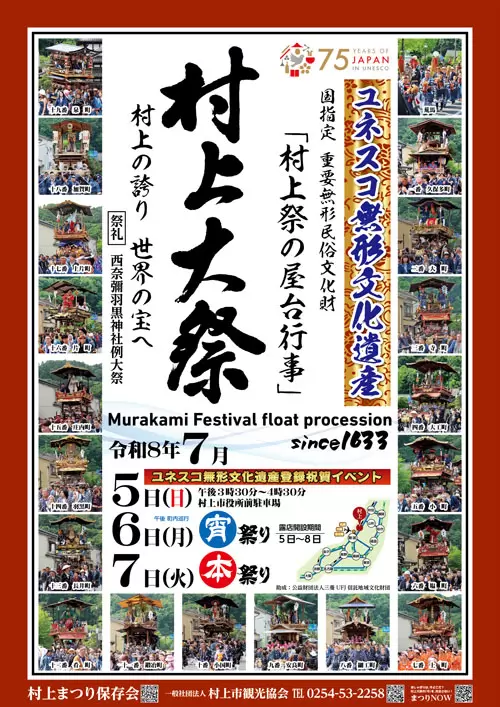
This year's Murakami Grand Festival is the first to be held since its designation as a UNESCO Intangible Cultural Heritage, so a large crowd and lively atmosphere are expected. Please come and experience the Murakami Grand Festival, the most vibrant event in Murakami City, a town in northern Niigata Prefecture!!
How to get to Murakami City, Niigata Prefecture
If you are going by plane
Direct flights to Niigata Airport are available from major airports in Japan.
● Osaka (Itami/Kansai International) → Niigata Airport…approx. 65 minutes ● Nagoya (Komaki/Chubu International) → Niigata Airport…approx. 60-65 minutes
*Please take the train (Shinkansen + Limited Express Inaho) from Tokyo.
Please take the limousine bus (approximately 25 minutes) from Niigata Airport to JR Niigata Station.
There is also the "Senami Onsen Direct Liner" (reservations required) which connects Niigata Airport to Murakami and Senami Onsen.
If you go by train
Please use the Shinkansen (bullet train) to travel from major Japanese cities to Niigata Prefecture (Niigata City).
●Tokyo Station to Niigata Station (Joetsu Shinkansen): Approximately 2 hours ●Shin-Osaka Station to Niigata Station (Tokaido Shinkansen): Approximately 4 hours 30 minutes
Please use the Uetsu Main Line to travel from Niigata City to Murakami City.
●Niigata Station ~ [Uetsu Main Line] ~ Murakami Station
[Limited Express Inaho] Approximately 1 hour [Local train] Approximately 1 hour 30 minutes
How to get around within Murakami City
The distance from JR Murakami Station to Nishina-mi Haguro Shrine is approximately 2km, a pleasant 25-minute walk. Other transportation options include taxis and rental bicycles.
Souvenirs from Murakami City
In Murakami City, processed salmon products are particularly popular as souvenirs. The city also produces sake such as "Shimeharitsuru" and "Taiyozakari." Murakami tea, with its mild flavor, is recommended for those unfamiliar with green tea. Among crafts, affordable chopsticks and accessories made with Murakami wood carving and lacquerware are popular with women.
Food events to enjoy during the Murakami Grand Festival
*During the Murakami Grand Festival, some shops may have altered business hours and operating days. Please inquire directly before visiting.
Murakami Donburi Battle 2026 Spring/Summer Edition (April 1st - September 30th)
You can enjoy donburi (rice bowls) featuring Murakami beef, local salmon, and plenty of fresh seafood at 25 participating restaurants.
Murakami Wild Rock Oysters 2026 (June 1st to mid-August)
Enjoy the large, flavorful natural rock oysters from Murakami City, which are in season during the summer.
Clothing and belongings during the Murakami Grand Festival
In early July, Murakami City in Niigata Prefecture typically experiences high temperatures and strong sunshine on sunny days. We recommend wearing a parasol or hat. Also, it often rains during the Murakami Grand Festival, so if rain is forecast, please bring a folding umbrella or rain gear. It can get chilly during early morning and evening visits, so it's a good idea to bring a light jacket or scarf.







![[Tokyo, Shinjuku] Buy Matcha Here! 2 Long-established Japanese Tea Shops Where You Can Get the Authentic Taste!](https://resources.matcha-jp.com/resize/720x2000/2025/09/24-245090.webp)


![[Kyoto Prefecture ] Let's go see Fukuchiyama Castle, the symbol of Fukuchiyama City | Highlights and seasonal events](https://resources.matcha-jp.com/resize/720x2000/2026/02/12-258435.webp)
![[Gozaisho Ropeway] Gourmet Guide](https://resources.matcha-jp.com/resize/720x2000/2025/12/03-251960.webp)
![[October/November 2026, near Tokyo Station] An event where you can buy popular souvenirs from all over Japan!](https://resources.matcha-jp.com/resize/720x2000/2026/10/14-272472.webp)