

Atami is known for its Toyotomi hot springs and scenic seaside scenery, and has been popular as a hot spring resort since the Edo period. The atmosphere of the hot spring town and the beautiful coastline attract many visitors.

Written by
The museum is built on a 230,000m2 hill in Atami, and you can see beautiful views of Izu Oshima and Hatsushima from the main lobby and Moore Square. The facility also features a garden that changes with the seasons, with cherry blossoms and azaleas in the spring, fresh greenery in early summer, and autumn leaves in the fall. Enjoy a relaxing resort-like experience while savoring art and nature. The museum opened in 1982, and 36 years later, from 2016 to 2017, it underwent renovation work to revamp the exhibition space and update the facilities. The lobby area and exhibition space were designed by the New Material Laboratory, which is headed by internationally renowned contemporary artist Hiroshi Sugimoto together with architect Tomoyuki Sakakida. We tackled the question of how to reconstruct and pass on the materials and techniques used in ancient, medieval, and early modern times in the present day, and through various attempts, we created a modern space using traditional Japanese materials, embodying the new MOA MUSEUM OF ART.
-
Table of Contents
- How to get to Atami
- Atami's hot springs and scenic spots
How to get to Atami

Atami's hot springs and scenic spots
1. Hashiriyu
This is a day-trip hot spring facility located near Oyu Geyser, one of the Seven Hot Springs of Atami. Oyu is a spring source that has existed in Atami since ancient times, and a natural geyser once erupted. It is said that Tokugawa Ieyasu secretly visited the hot springs during the Edo period, and the hot spring water that gushed out from the geyser was transported to Edo Castle as "Okumiyu" (water pumped from the geyser) for successive shoguns.
Hashiri-yu (Running Bath)

2. Nikkotei Oyu
This is a day-trip hot spring facility located near Oyu Geyser, one of the Seven Hot Springs of Atami. Oyu is a spring source that has existed in Atami since ancient times, and a natural geyser once erupted. It is said that Tokugawa Ieyasu secretly visited the hot springs during the Edo period, and the hot spring water that gushed out from the geyser was transported to Edo Castle as "Okumiyu" (water pumped from the geyser) for successive shoguns.

3. Furuya Ryokan
Founded 200 years ago, this historic inn has a hot spring source called "Kiyozaemon no Yu," one of the Seven Hot Springs in Atami. During the Meiji period, the literary figure Tokutomi Soho frequently stayed here. Since the time of the inn's founding, the hot spring water has been kept flowing directly from the source without adding water, circulating, or overheating, and continues to attract guests to this day.

4. Atami Garden
The garden opened in 1886 as a new leisure spot in the town of Atami, which was thriving as a hot spring resort at the time. The plum trees, planted on a 33,000m2 plot of land in the mountain valley, are known as the earliest-blooming plum trees in Japan, with the first blossoms appearing between late November and early December every year. The Atami Garden Plum Festival is held every year from January to March, attracting many tourists.

5. Hatsu Island
Hatsu Island is the only remote island in Shizuoka Prefecture , located in Sagami Bay , and is thought to have been created around 50,000 years ago. It has long been known as a scenic spot, and in the Kamakura period it appeared in a poem written by Minamoto no Sanetomo when he visited Hakone and Izu. Today, it is said to be the island closest to Tokyo, and tourists visit it as a diving spot and a resort with a coastline.

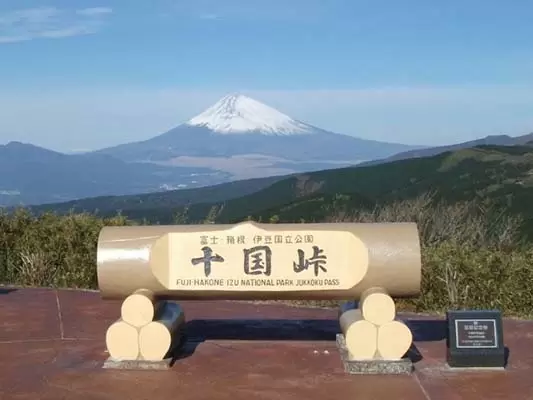
6. Jikkoku Pass
This pass, north of Atami, leads to the Hakone outer rim and is designated as a national registered monument. It is said that the name comes from the fact that it once overlooked the "Ten Provinces (Izu, Sagami, Suruga, Kai, Kai, Awa, Kazusa, Shimousa, Musashi, Shinano) and the Goto(Oshima, Niijima, Kozushima, Miyake Island, Toshima)." Currently, a cable car runs from the middle of the mountain to the summit, and you can enjoy a 360° view including Mount Fuji.






![[Tokyo, Shinjuku] Buy Matcha Here! 2 Long-established Japanese Tea Shops Where You Can Get the Authentic Taste!](https://resources.matcha-jp.com/resize/720x2000/2025/09/24-245090.webp)


![[Kyoto Prefecture ] Let's go see Fukuchiyama Castle, the symbol of Fukuchiyama City | Highlights and seasonal events](https://resources.matcha-jp.com/resize/720x2000/2026/02/12-258435.webp)
![[Gozaisho Ropeway] Gourmet Guide](https://resources.matcha-jp.com/resize/720x2000/2025/12/03-251960.webp)
![[October/November 2026, near Tokyo Station] An event where you can buy popular souvenirs from all over Japan!](https://resources.matcha-jp.com/resize/720x2000/2026/10/14-272472.webp)